Hello.
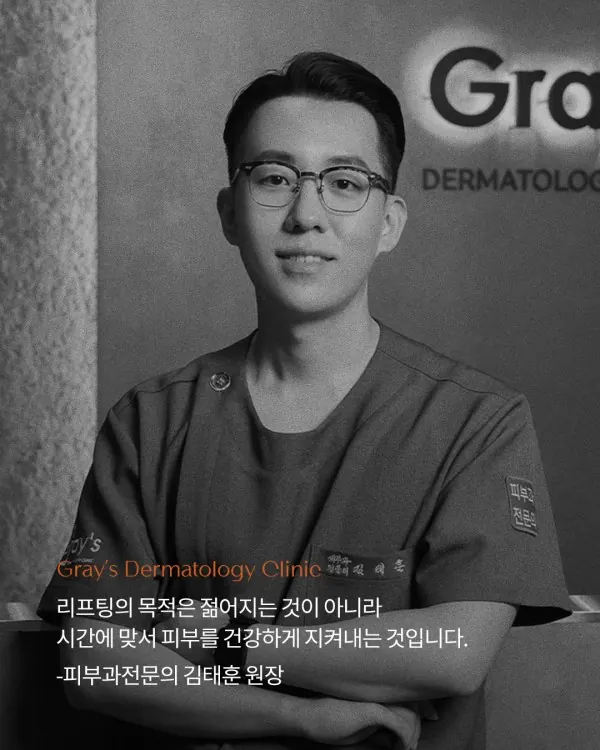
I'm Dr. Tae Hoon Kim, board-certified dermatologist, thinking about your skin 10 and 20 years from now.
In a board-certified dermatologist's view, the most ideal skin is skin that, from the deep layers,
is firmly supported and has a dense, plump-looking volume.
Of course, keeping skin like this into your 40s may partly be something you are born with,
but I imagine it also took endless effort to maintain healthy skin.
Another feature of healthy skin is that it is backed by 'resilience'.
Because its own ability to regenerate is strong even against external stressors such as UV rays, it can recover fully and maintain its tone, texture and glow.
Unfortunately, skin this good is not easy to get just by spending a lot of money at a dermatology clinic.
This is because it has to be backed by everyday skin habits that keep the skin barrier and skin condition consistent.
But! It's not too late yet.
Today, I'd like to explain what people who are still told they have great skin in their 40s have in common.
By the time you finish reading, you'll probably find yourself nodding in recognition :)
- You need to be good at adding and subtracting.
When it comes to skin care, many people think only of treatments that soften fine lines or
lifting treatments that can improve sagging, but choosing treatments with this approach is like throwing money away.
Aging appears in several layers of the skin at the same time, so if the skin's support has weakened,
you might consider a mid/low-frequency treatment that targets the fascia and muscle, right?
And if the ECM environment of the dermis has broken down, an injection treatment that replenishes effective regenerative components to make up for it may be more suitable.
And if volume is the issue, a relatively simple filler treatment alone can be enough to ease it.
The problem is that people often do not really know what skin problem they have.
That is why I say a consultation with a board-certified dermatologist is essential.
Based on an understanding of skin anatomy, a board-certified dermatologist can pinpoint what is needed to create a natural face with a better aesthetic balance.
Then they select only the treatments that suit you and are truly necessary, and put together a long-term plan.

Speaking of our clinic's signature treatments, Ulthermage cannot be left out.
It combines Thermage FLX, based on RF radiofrequency, with
Ultherapy PRIME, based on HIFU focused ultrasound energy, to deliver energy from the outer layer of the skin to relatively deep layers.
Laser lifting strengthens support through immediate tissue contraction and also has the effect of lifting sagging skin, and over time, as the skin gradually regenerates and recovers, it creates healthy skin.
The dermis naturally contains components such as collagen, elastin and hyaluronic acid.
Each has its own function, but with aging these components decrease and their functions weaken, which causes various problems.
Thermage FLX restores this weakened dermis and promotes regeneration, changing it into healthy skin that anyone would say looks good.
Ulthermage at our Marine City-area clinic follows the principle of 'low-pain, high-output lifting'.
Pain is reduced while the treatment can be performed at a higher level, and satisfaction also tends to be very high.
If you have wanted laser lifting but hesitated because of pain, feel free to knock on our door.

We once had a phone call at the clinic.
The caller asked whether Oligio could also be done on areas such as the forehead, around the eyes and around the mouth.
The answer, of course, is yes.
Because of resistance, radiofrequency treatments tend to stay in the outer layers of the skin, and know-how is essential to send the energy deeper.
Also, relatively thin skin can be prone to side effects such as burns, so the treatment must be carried out under a careful plan by a board-certified dermatologist to proceed stably.
Occasionally, people with thin skin who look older because of a lack of facial volume want filler, especially in the lower face.
In such cases, our Marine City-area clinic never performs filler treatment.
The reason is simple.
If filler is injected into the lower face when firmness has already declined, the tissue stretches
and weight is added, which carries a risk of greatly reducing the aesthetic result in the long term.
As you can see, whether a treatment goes ahead can depend on the area and the concern,
so let me say it again: a consultation with a board-certified dermatologist is a very important first step.

If you are searching for anti-aging treatments and comparing several clinics,
I would really urge you not to choose a dermatology clinic based only on how close it is to home, its prices or its device names.
Of course, the factors listed above matter too, but most important of all is to accurately identify the cause of your skin concern
and to find a dermatology clinic that can apply various approaches to ease it and design your treatment accordingly.
And this judgment belongs solely to the 'medical team' — not to a consultation manager or staff.
Please remember that being treated properly at the right place from the start is, in the end, the fastest route,
and if that is difficult, I recommend having consultations at at least 2–3 clinics and comparing them.
The medical information on this website is general guidance only. Diagnosis and treatment may differ depending on your individual condition — please obtain an accurate diagnosis through an in-person consultation.