Hello.
I'm Dr. Tae Hoon Kim, board-certified dermatologist at Grays Dermatology in Haeundae, Busan.
Every reason people come to a dermatology clinic starts with the mirror.
A jawline that isn't what it used to be, nasolabial folds, fine lines around the eyes… your skin's age shows just as it is, doesn't it?
There is something I tell everyone who comes to me about skin firmness.
If you're looking for a lifting procedure to turn back the signs of aging I just mentioned, it's advisable to see a board-certified dermatologist.
Today I'd like to talk about Ulthermage — the Ultherapy + Thermage combination — a lifting treatment that a board-certified dermatologist vouches for.
As many of you know, it is a treatment that combines Ultherapy PRIME and Thermage FLX, and it is also one of our clinic's signature programs.

Skin is not a single sheet; it is made up of several layers.
Epidermis - dermis - subcutaneous fat and the fascia layer — and recently, lifting devices that deliver energy even deeper than that are being developed.
With aging, collagen and elastin decrease in the dermis, the fascia loosens as well, and the fat layer descends in the direction of gravity.
Eventually, sagging appears and the facial lines break down.
A good lifting procedure is one that delivers energy precisely so as to counter the aging that occurs in each of these layers.

Ultherapy PRIME is a procedure that uses high-intensity focused ultrasound (HIFU) technology to deliver energy precisely to the fascia layer without damaging the skin's surface.
The fascia layer is a key layer that maintains the face's supporting structure and is related to the jawline, nasolabial folds and overall facial sagging.
Ultherapy PRIME creates thermal coagulation points (more than about 1,000 tiny points) in this fascia layer, causing the fibrous tissue to contract and stimulating new collagen to regenerate.
As a more effective procedure for improving a double chin, nasolabial folds, fine lines around the eyes and between the brows, and for refining the facial contour,
it plays the role of ‘building the basic framework,’ handling deep structural lifting within the skin.
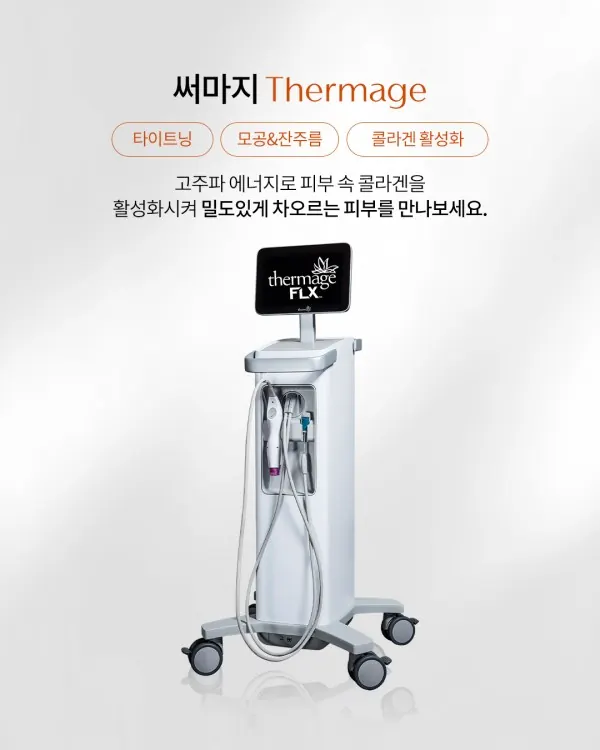
Smoother skin texture with low-pain, high-output Thermage FLX
Thermage FLX, on the other hand, uses radiofrequency (RF) energy to heat the skin evenly to a depth of about 1.5–3.0mm from the surface, inducing immediate firmness and long-term regeneration.
Generally, when people talk about Thermage FLX, some immediately think of sedation, because the aversion to the pain is so strong.
The more procedures I perform with Thermage FLX, the more I feel that sedation is becoming less and less necessary.
Typically, when treating at level 2.0–2.5 based on 600 shots, the total energy comes to around the low-to-mid 30 kilojoules,
but even though the energy I deliver is about 1.5 to 1.8 times that or more, pain scores are at most 3 out of 10, and some people feel almost no pain and are fine going up to level 4.5.
Of course, a special anesthesia system plays a part, but I'd like to say that I have the know-how to reduce pain while raising the energy of a radiofrequency device.
In truth, since it's not something you can see with your eyes, you have no choice but to rely on the know-how and feel of the medical team.
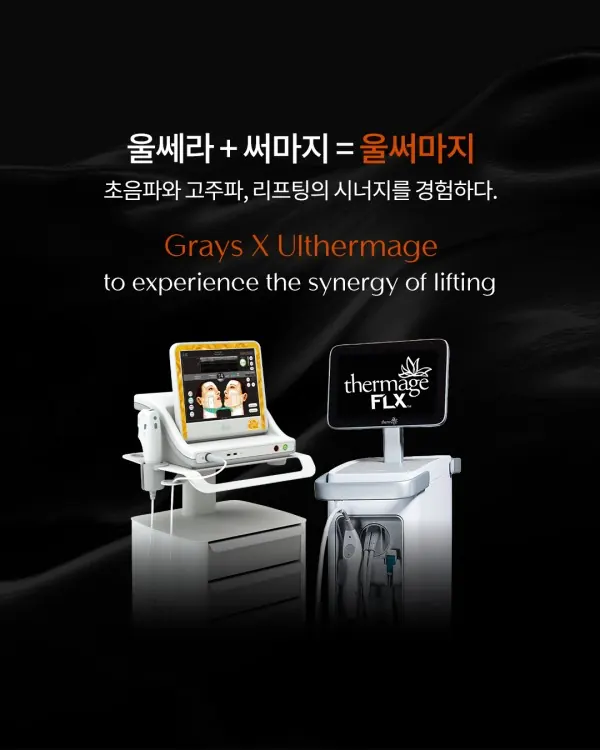
By using the two devices, Ultherapy PRIME and Thermage FLX, together, every layer of the skin can be stimulated in fine detail.
Ultherapy PRIME lifts, and Thermage FLX tightens.
Combination lifting can be described as synergy lifting — lifting the structure from below while refining the surface from above.
Because results differ depending on the order, depth, intensity and distribution of energy, you must find a medical team with expertise in aesthetic medicine.
The results of a lifting procedure are determined not by the device but by the medical team's ability to design the treatment,
and even with the same device, results vary enormously depending on the depth, order, direction and energy values used.
When I design a lifting procedure, I analyze each patient's face like a map.
I analyze comprehensive data such as skin thickness, the distribution of the fat layer, the position of the fascia, the direction of aging and wrinkle patterns, so that the optimal energy is delivered to each layer.
This is the 1:1 customized lifting of board-certified dermatologist Dr. Tae Hoon Kim.

To say it once more: with Ultherapy + Thermage, results differ according to precise control of the energy depth, settings matched to the thickness of the fascia, and a treatment direction that follows the curves of the face.
I think of lifting not as a technique but as a medicine of sensibility.
Like a painter holding a fine brush, you must be able to read the subtle flow of the facial lines to create results that are clear without being excessive.
Depending on each person's facial structure, skin thickness, age and direction of aging, I design everything differently, from energy depth, output and shot distribution to the order of combined procedures.
Because lifting is a process of understanding and fine-tuning the skin's structure, handling the machine well is important, but even more important is the medical team's ability to design the treatment. I'll close this long post hoping you'll keep that in mind.
This was Dr. Tae Hoon Kim, board-certified dermatologist and Medical Director of Grays Dermatology.
The medical information on this website is general guidance only. Diagnosis and treatment may differ depending on your individual condition — please obtain an accurate diagnosis through an in-person consultation.